Zero to One
Notes on Startups, or How to Build the Future
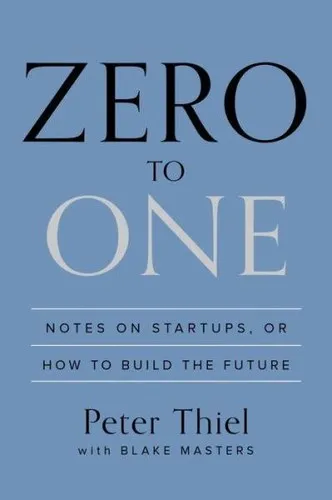
- Authors
- Peter Thiel, Blake Masters
- Published
- Publisher
- Crown Business
- Pages
- 224
Preface
“Every moment in business happens only once.” The next Bill Gates won’t build an operating system. The next Larry Page won’t build a search engine. The next Mark Zuckerberg won’t build a social network.
It’s easy to copy and go from 1 to N, but going from 0 to 1 is hard.
Unless companies invest in the difficult task of creating new things, they will fail in the future, no matter how big their profits remain today.
Technology enables creating new things. This is what distinguishes humans from other species.
My take:
This relates to the principle of “Sell painkillers, not vitamins”. For starters, you don’t need to build the next Twitter, or the next Netflix, or the next YouTube. A simple painkiller approach would be to find a pain point that the YouTuber community faces, solve it, and make their lives easier.
That a company won’t survive if it doesn’t invent is true for small and big companies alike. You may build a painkiller that sits on top of other technologies and get a revenue stream. But in the long run, the company will have to invent in its space or pivot to survive and thrive for decades. Otherwise, the better strategy would be to get sold or merged.
If you are starting from scratch, focus on being problem-first rather than technology-first, if you don’t have the resources to build the technology to be the next big thing.
Chapter 1: The Challenge of the Future
The authors open the chapter with a contrarian question: “What important truth do very few people agree with you on?”
A good answer takes the form “Most people believe X, but the truth is the opposite of X.”
Their own answer: “Most people think the future of the world will be defined by globalization, but the truth is that technology matters more.”
Globalization is horizontal progress — scaling what already works, going from 1 to N. Technology is vertical progress — building something new, going from 0 to 1.
The book is not a manual. It is an exercise in thinking: the questions you must ask and answer to succeed in the business of doing new things.
Any new technology is rooted in the present. It defines the future by making the world look different from today.
Mass-producing a typewriter and selling it in every country is horizontal progress — globalization. Building a word processor is vertical progress — new technology.
My take:
My answer to the contrarian question: most people think speed and quality are inversely proportional, that you trade one for the other. The truth is that they sit on the same spectrum. With practice, you can deliver quality at speed.
Chapter 2: Party like it’s 1999
Madness is rare in individuals - but in groups, parties, nations, and ages it is the rule.
Distortions caused by a bubble don’t disappear when they pop.
In this chapter the author walks us through the quick history of the 1990’s that it was not as optimistic as we remember it.
And Paypal’s customer acquisition strategy of giving $10 to new customers for joining and $10 when they referred a friend. The customers grew at an exponential rate and so did the cost which was unsustainable. But with a large user base, Paypal had a clear path to profitability and raised funding before the dot-com crash.
The lessons learned from the dot-com crash:
- Make incremental advances
- Stay lean and flexible
- Improve on the competition
- Focus on the product, not sales
Yet the opposite principles are also correct:
- It is better to risk boldness than triviality
- A bad plan is better than no plan
- Competitive markets destroy profits
- Sales matters just as much as product
My take:
I don’t think the above lessons are contradicting each other. They are actually complementing. It totally depends on the current state of the business you are in which depends on the following:
- If you have a stable profitable business then you can take more risk in a different domain or market. If you have a large customer base, then incremental advances makes sense.
- It’s better to ship fast, get feedback and iterate quickly. Avoid planning overkill, execute and learn.
- If there is a competition who has a revenue means the market discovery is done. Else find a niche market.
- Sell before you build. Improve product quality to keep the customers happy.
Chapter 3: All Happy Companies are different
There are companies that create enormous value but capture less value for themselves - like airlines. There are companies that create less value but capture far more than they create - like Google.
There are 2 simplified models to explain the difference - Perfect Competition and Monopolies.
Competitive Lies: Non-monopolists exaggerate their distinction by defining their market as the intersection of various smaller markets.
There are endless options when it comes to visiting a cafe in Mumbai. In Bandra, we have so many but one that personally stands out to me is - Mary Lodge by Subko
It’s an intersection of
Coffee Training ^ Co-working ^ In-house beans and bakes
Monopoly Lies: Monopolists disguise their monopoly by framing their market as the union of several large markets.
Zomato in public doesn’t frame itself as a food delivery app even though they have a market share of 55 to 58% here. They claim their competition is home-cooked food, which makes the union of
Food Delivery U Dining Out U Home Cooked Meals U Quick Commerce U Catering
Companies in perfect competition have to focus so much on their day-to-day survival that they cannot plan for the long term.
On the other hand, Creative Monopolists add more categories of abundance to the world and are powerful engines to make society better.
All happy companies are different - they solve a unique problem. All unhappy companies are the same - they fail to escape competition.
My take:
If you want to build a company that is long-lasting and a giant like Apple or Google, you’ll need to differentiate by creating your own market as a Creative Monopoly.
I don’t think everyone who’s building a business will be able to achieve that. It all depends on your goals and ambitions as an entrepreneur. Those who are driven by innovation should go for this approach.
I think it’s fine if you want to establish your company in a perfectly competitive market where you create your own differentiation if it is sustainable.
Chapter 4: The Ideology of Competition
Creative Monopoly = benefit to consumers + profit to creator
Competition = no meaningful differentiation for consumers + no profits + struggle for survival
The rest of chapter gives various examples of how Competition kills proft and create stupid rivalries.
The only learning from this chapter is that if you can’t beat a rival, it may be better to merge.
In 1999, PayPal and X merged to survive the Dot-Com bubble burst and build a succesful business.